
Key takeaways
- Article 50 of the EU AI Act applies since 2 August 2026. The brand that publishes an AI picture is the deployer and owns the visible disclosure; the vendor that generates it is the provider and owns the machine-readable mark.
- A machine-readable mark means at least two layers in the file: digitally signed metadata and an imperceptible watermark. A caption on the page is not a mark.
- Marketplaces have their own rules: one bans on-image labels and wants invisible marking, one wants a keyword in the file metadata, one wants an IPTC tag preserved.
- Most pipelines strip metadata without telling you. Test every hop from export to the live page with a verifier before you rely on the mark.
Since 2 August 2026, publishing an AI-generated product photo in the EU comes with a transparency duty. The questions we hear from e-commerce and legal teams are about the mechanics: who has to label, what "machine-readable" means for a JPEG, where a visible label can go on a product page, and whether the mark is still there after a PIM, a retouching round, a CDN and a marketplace upload.
This article walks through AI Act product images in that order, from the practice of producing and delivering AI on-model imagery for fashion e-commerce. It is not legal advice: the guidance is recent and some interpretations will move, so every date and rule links to its source for your counsel to check.
Who has to do what under Article 50
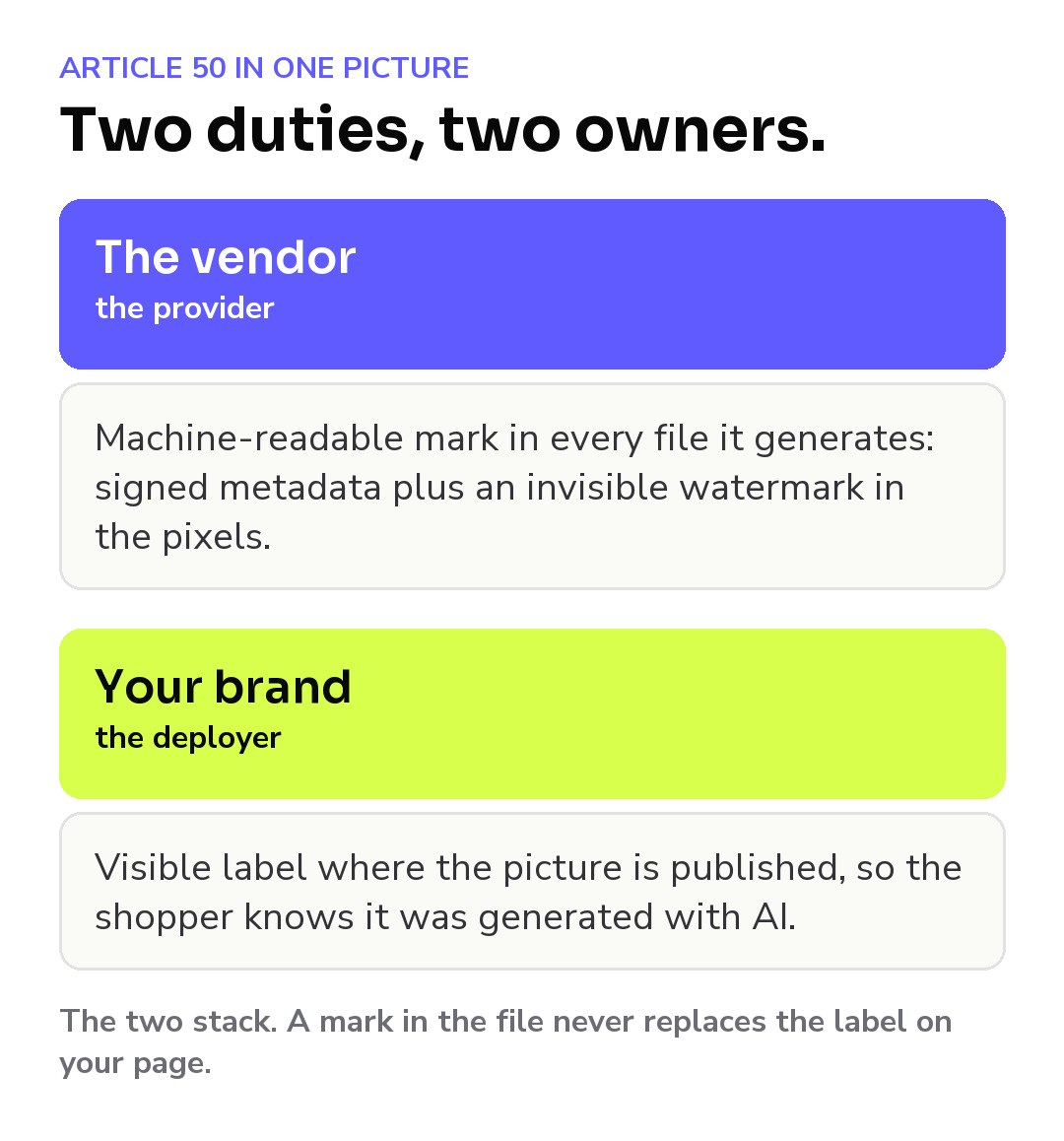
The European Commission's FAQ on Article 50 (updated 24 July 2026) separates two roles:
- Providers develop an AI system and place it on the market under their own name. Under Article 50(2) they must make sure outputs are marked "in a machine-readable format and detectable as artificially generated or manipulated".
- Deployers use an AI system under their own authority in a professional context. Under Article 50(4) they must clearly label deepfakes, defined as content that resembles existing persons, objects, places or events and would falsely appear authentic.
For a fashion brand this means the vendor generating the pictures carries the marking duty, and the brand publishing them carries the labelling duty on its own channels. The two obligations stack rather than substitute.
Whether a studio picture of a synthetic model wearing a real garment is a deepfake is left to interpretation. The Commission's three cumulative criteria are resemblance, existence and false appearance of authenticity. A real product on a model that does not exist sits close enough to that line that, in our experience, brand legal teams choose to label rather than argue the exception.
The dates that matter
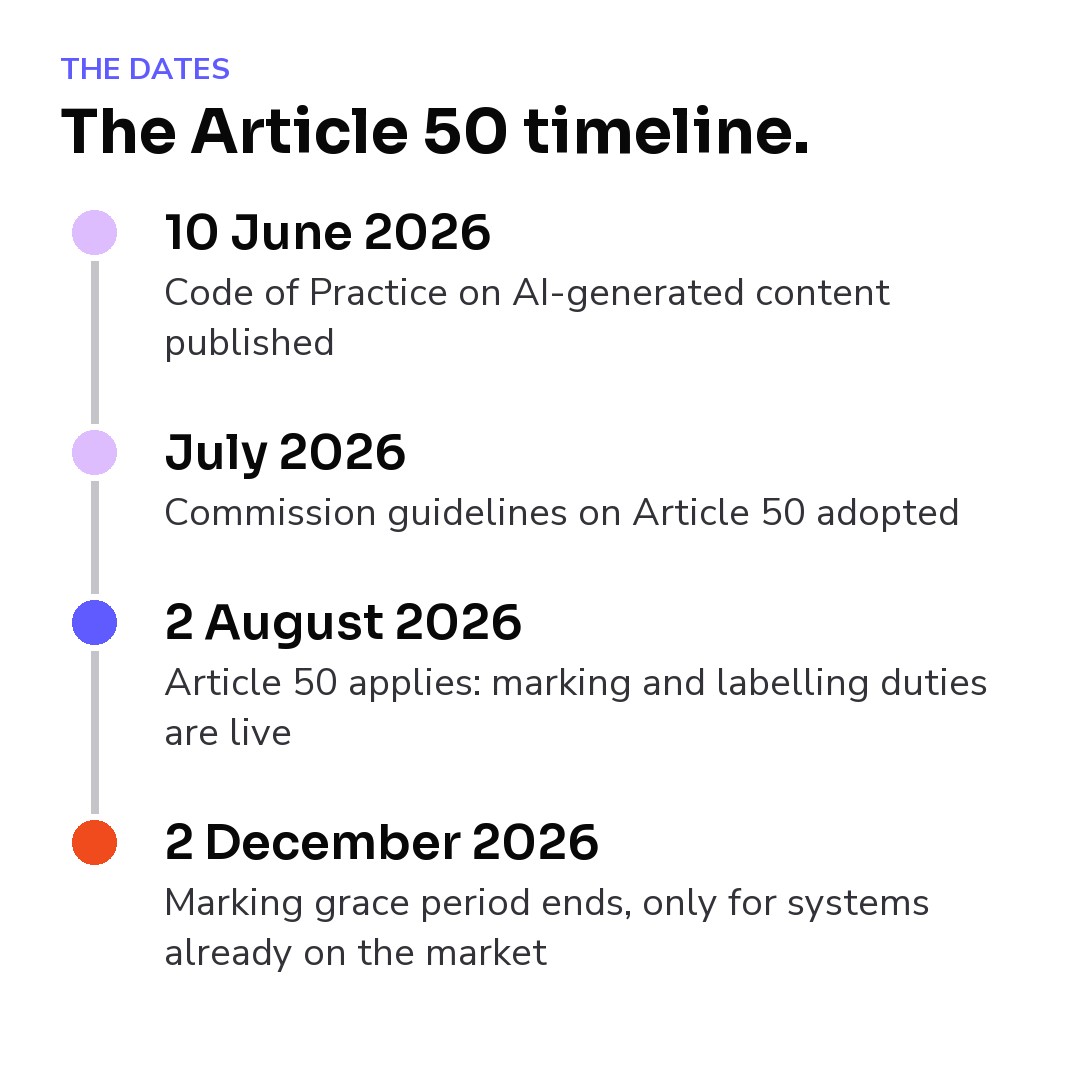
| Date | What happens | Source |
|---|---|---|
| 2 August 2026 | Article 50 applies: provider marking (50(2)) and deployer labelling (50(4)) duties are live | Commission FAQ |
| 2 December 2026 | End of the grace period for marking, only for generative systems already on the market before 2 August 2026 | Commission FAQ |
| 10 June 2026 | Final Code of Practice on transparency of AI-generated content published by the AI Office | IPTC |
| July 2026 | Commission guidelines on Article 50 adopted | Commission guidelines page |
Content generated before 2 August 2026 does not need retroactive labelling, as Morgan Lewis notes, and the grace period helps providers, not deployers: a brand publishing AI pictures today already has the labelling duty.
Step 1: get the machine-readable mark into the file
The Code of Practice is where "machine-readable" becomes concrete. As the IPTC summary explains, no single technique currently meets all four legal requirements of effectiveness, interoperability, robustness and reliability, so providers are expected to apply at least two layers:
- Digitally signed metadata, signed and time-stamped in a tamper-evident way. In practice this is a C2PA manifest, also called Content Credentials, carrying what tool produced the image and what edits followed.
- An imperceptible watermark woven into the pixels, which survives a metadata strip.
A third mechanism, fingerprinting against a registry, is optional.
Alongside the signed manifest, keep the plain IPTC DigitalSourceType property set to trainedAlgorithmicMedia, the standard vocabulary term for an image created by a generative model, because platforms read it. Ask your vendor to show you these layers on a delivered file, not on a slide; a metadata reader and a C2PA verifier take a minute.
What a correctly marked file carries
- C2PA manifest: signed and time-stamped, stating the image was created with a generative AI system.
- IPTC:
DigitalSourceTypeset totrainedAlgorithmicMedia.- XMP: the keyword
contains-synthetic-performerindc:subject, when the picture shows an AI-generated person and goes to Amazon.- Pixels: an imperceptible watermark that survives a metadata strip.
A one-minute check on any delivered file, with the free command-line tools ExifTool and c2patool:
exiftool -DigitalSourceType a.jpg
c2patool a.jpg
Step 2: decide where the visible label goes, channel by channel
The visible label is the deployer's duty, and every channel treats it differently. The table below reflects the public rules we work with daily, as published in October 2026.
| Channel | Visible label on the image | Machine-readable mark | Practical note |
|---|---|---|---|
| Your own shop | Allowed and expected; a caption, badge or gallery note near the image | Keep C2PA, IPTC and watermark in the delivered file | Decide one placement and keep it across the catalogue |
| Zalando | Not allowed: on-image text overlays and watermarks are rejected, and content that legally requires a visible label is not accepted | "Strongly recommended" invisible marking in metadata or watermark; metadata "must be permanent so it isn't stripped during upload" | Zalando image guidelines, updated 1 October 2026 |
| Amazon | The marketplace renders its own disclosure "where applicable" | Keyword contains-synthetic-performer in the XMP dc:subject field for photorealistic AI people |
Policy announced July 2026, tied to New York law, per eWeek |
| Google Shopping | No overlay required | IPTC DigitalSourceType must be kept on image_link, additional_image_link and lifestyle_image_link |
Merchant Center help |
| Social platforms | Use the platform's own AI label toggle | Most strip embedded metadata on upload | Treat the file mark as lost once posted |
A marketplace that forbids overlays does not remove the deployer's duty; it moves the disclosure into the file and into the marketplace's own interface. The same picture may carry a burned-in label on one channel and none on another, which makes the label a per-destination export setting, not a per-picture decision.
Step 3: test whether the mark survives your pipeline
This is where many compliance plans break, and it breaks silently. An image optimiser reports success and delivers a smaller file with the manifest gone.
The data — Fastly states that its image optimizer "stripped away metadata by default, prioritizing performance and file size reduction" before it added C2PA support, per its engineering blog. Cloudflare Images likewise documents a specific option to preserve Content Credentials through transformations, which has to be enabled.
The underlying problem is simple. A C2PA manifest signs the pixels, so any resize, crop or re-encode invalidates the signature unless the tool re-signs the result. IPTC and XMP fields are not signed and can survive a transformation, but many tools drop them anyway. The watermark is the layer most likely to come through, which is exactly why the Code asks for it.
A walk through the hops
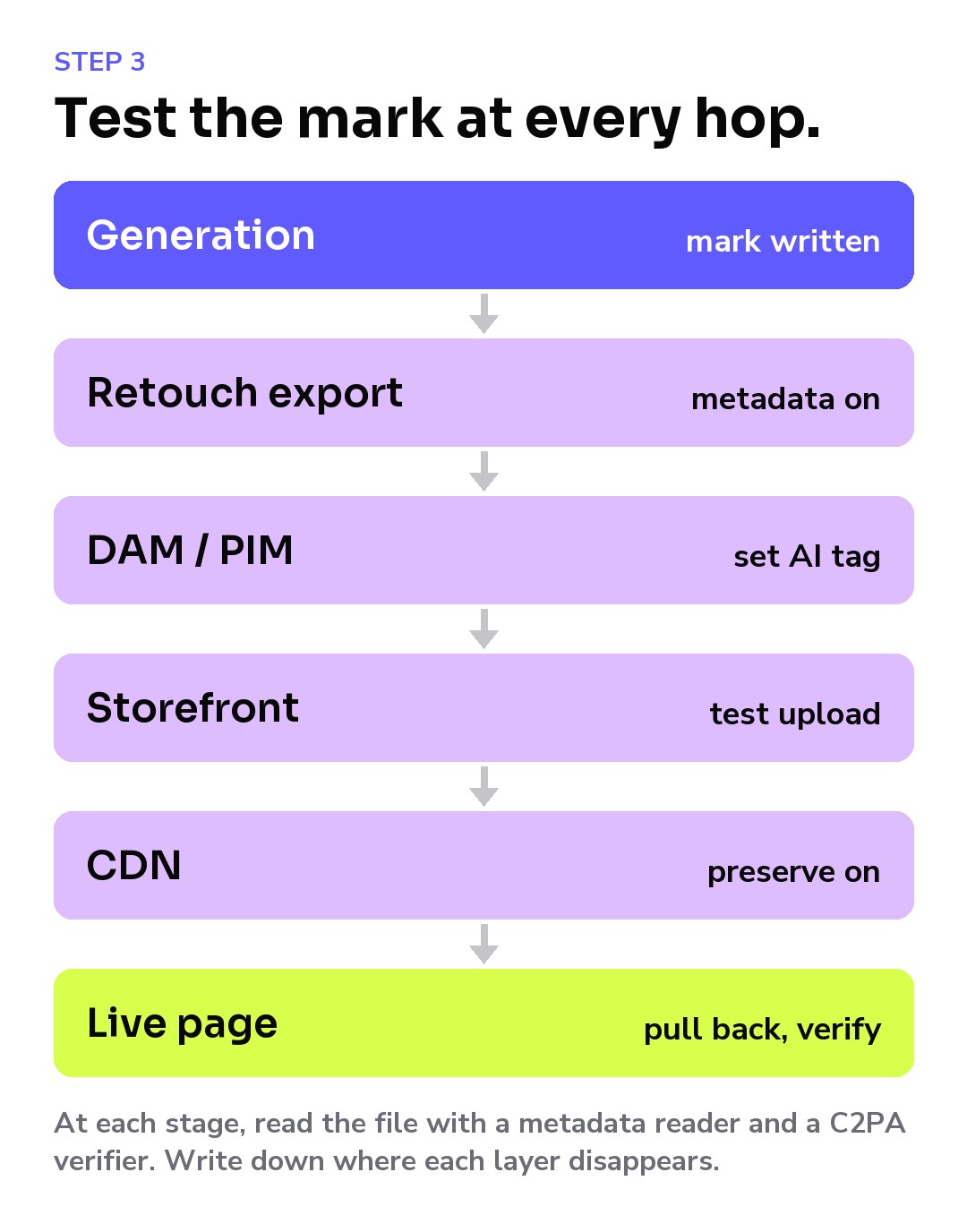
In our own spot checks of fashion pipelines, the mark dies at predictable places:
- Retouching export. An export dialog set to "no metadata" removes the IPTC and XMP fields along with the manifest. The retoucher sees no difference.
- Storefront platform upload. In our tests, storefront uploads commonly keep the IPTC fields but drop the C2PA manifest: the file still says "AI" to a metadata reader, but no longer carries a signed proof.
- CDN or image optimiser. Default settings strip everything, as the vendors above confirm.
- Marketplace ingestion. The file is re-encoded to the marketplace's size and background; what survives depends on its pipeline.
- DAM re-save. Some DAMs rewrite the file on ingest; the AI tag then has to be set by hand in the DAM's own field.
The test is cheap: push one delivered file through each hop and read it at every stage with a metadata tool and a C2PA verifier. The table of where each layer disappears is what your legal team actually needs.
Step 4: keep the record, not just the mark
A label proves what the file says today. A record proves what was done and who approved it. If a platform or an authority asks about a picture a year from now, you want the generation parameters, the model version, the edits applied and the approval trail, not a screenshot. Per picture, keep: which AI system and version produced it, the signing chain of the manifest, the edits made after generation, who approved it and when, and which channels it went to with which label setting.
How Sartiq handles it
Sartiq produces the pictures, so under Article 50 we are the provider. Every output carries three marking layers applied automatically: C2PA Content Credentials, EXIF and XMP metadata, and an imperceptible watermark. A visible "AI Generated" label is available and rendered onto delivered files before they reach your pipeline, toggled per channel, because the visible disclosure duty sits with the publishing brand. Each download comes with a per-file disclosure receipt, and every output retains an exportable provenance trail: prompt, parameters, model version, signing chain and revision ID. The approval registry records who approved which image and when. Our position under the AI Act is Limited Risk under Article 50, with the analysis available to your counsel; this supports your Article 50 transparency obligations and does not replace legal advice.
Key points to remember
- The brand publishing the picture is the deployer and owns the visible label. The vendor is the provider and owns the machine-readable mark. Neither replaces the other.
- Article 50 has applied since 2 August 2026. The December 2026 grace period is for providers of systems already on the market, not for publishers.
- A compliant mark means at least two layers in the file: signed metadata and an invisible watermark. Keep the IPTC
DigitalSourceTypetag as well, because platforms read it. - Marketplaces differ: one forbids overlays and wants invisible marking, one wants a metadata keyword, one wants the IPTC tag preserved. Set the label per destination.
- Test the whole pipeline with a verifier. Resizes and re-encodes break signatures; default optimiser settings strip metadata.
- Keep the provenance record and the approval trail, not just the file.
FAQ
Is a line in the product description such as "image generated with AI" enough? It can serve as the visible disclosure on your own shop if it is clear and shown at first exposure, but it is not a machine-readable mark. Article 50(2) requires the mark in the file itself, and platforms like Google Shopping read the IPTC tag, not your copy.
Our vendor says the files are marked. Do we still need to do anything? Yes. The visible label on your channels is your duty as the deployer, and the file mark must still be there when the picture goes live. Check a delivered file, then check the same picture on the live page.
Does a watermark burned into the image satisfy the marketplace rules? Not on every channel. Zalando's guidelines reject visible overlays and watermarks and point to invisible marking in metadata or an imperceptible watermark instead. A burned-in label is a per-channel setting, not a default.
Can a resized image keep its Content Credentials? Only if the tool that resizes it re-signs the result. Ask your CDN or image service whether it preserves or re-signs C2PA, and test it.