
Key takeaways
- AI product imagery is already live. On most of the shops we checked by hand we found AI-generated pictures, videos or banners; on the shop with the widest adoption, a large share of the sampled products carried AI on-model pictures.
- Labelling is inconsistent. Where AI imagery was present, most shops showed a visible label, some showed none, and the forms ranged from a badge to a burned-in watermark.
- The file mark mostly dies in the pipeline. A signed credential survived to a live page on a single shop. Several marketplaces returned files with no metadata at all.
- When AI on-model pictures go wrong, they go wrong on the product. Of the errors we confirmed, metal hardware was the most frequent category, construction next, then buttons, logos and details that change between views.
Since 2 August 2026, Article 50 of the EU AI Act asks whoever publishes AI-generated content to make it recognisable, and whoever generates it to mark it in a machine-readable way. We wanted to know what that looks like today on real fashion product pages, not in policy documents. So in autumn 2026 we audited AI product images on retailer sites: live shops checked by hand, from luxury marketplaces to a brand's own site, delivery platforms tested with our own files, and a metadata-only scan of many more sites.
This is a report, not a ranking. No shop is named, and we do not read any finding as bad faith: most of it is the natural result of image pipelines built before a picture needed to carry proof of how it was made. It is not legal advice.
How we checked
Every shop went through the same steps, in this order.
- Read the page's own disclosure first. Some shops flag each picture in the page data and render a badge from it. If a shop says a picture is AI, that is the answer, whatever the pixels look like.
- Read the file. We downloaded the full-size images and looked for the IPTC Digital Source Type field, which has a standard value for pictures made by a generative model, and for a C2PA manifest, the signed credential also known as Content Credentials.
- Screen still life against the on-model views. A vision model compared each product's flat packshot with its worn pictures and flagged mismatches as leads.
- Confirm every lead by eye, at full size. No lead counted until a human saw the difference on the live picture and on the packshot.
One rule shaped the whole report: a clean visual check proves nothing. Current generations pass a close look, so where a shop showed no label and the file carried no mark we recorded "no evidence either way", never "real".
The data — Live fashion shops audited by hand in autumn 2026, from a few dozen to a few thousand product pages each, plus delivery-platform tests on our own files and a metadata-only scan of many further shops in the EU, UK and US. The Article 50 date is from the European Commission's FAQ on transparency obligations.
Finding 1: AI imagery is live on most of the shops
| Check | What we found |
|---|---|
| AI imagery found on the site | Most shops: on-model pictures, product video or editorial banners. A few: no evidence either way |
| Shopper-visible label, where AI was found | Most shops show one, in very different forms; some show none |
| AI tag still in the live file, where AI was found | Rare; one shop keeps it in a single image size only |
| Signed credential on the live page, where AI was found | A single shop, on its banners; elsewhere none or not checked |
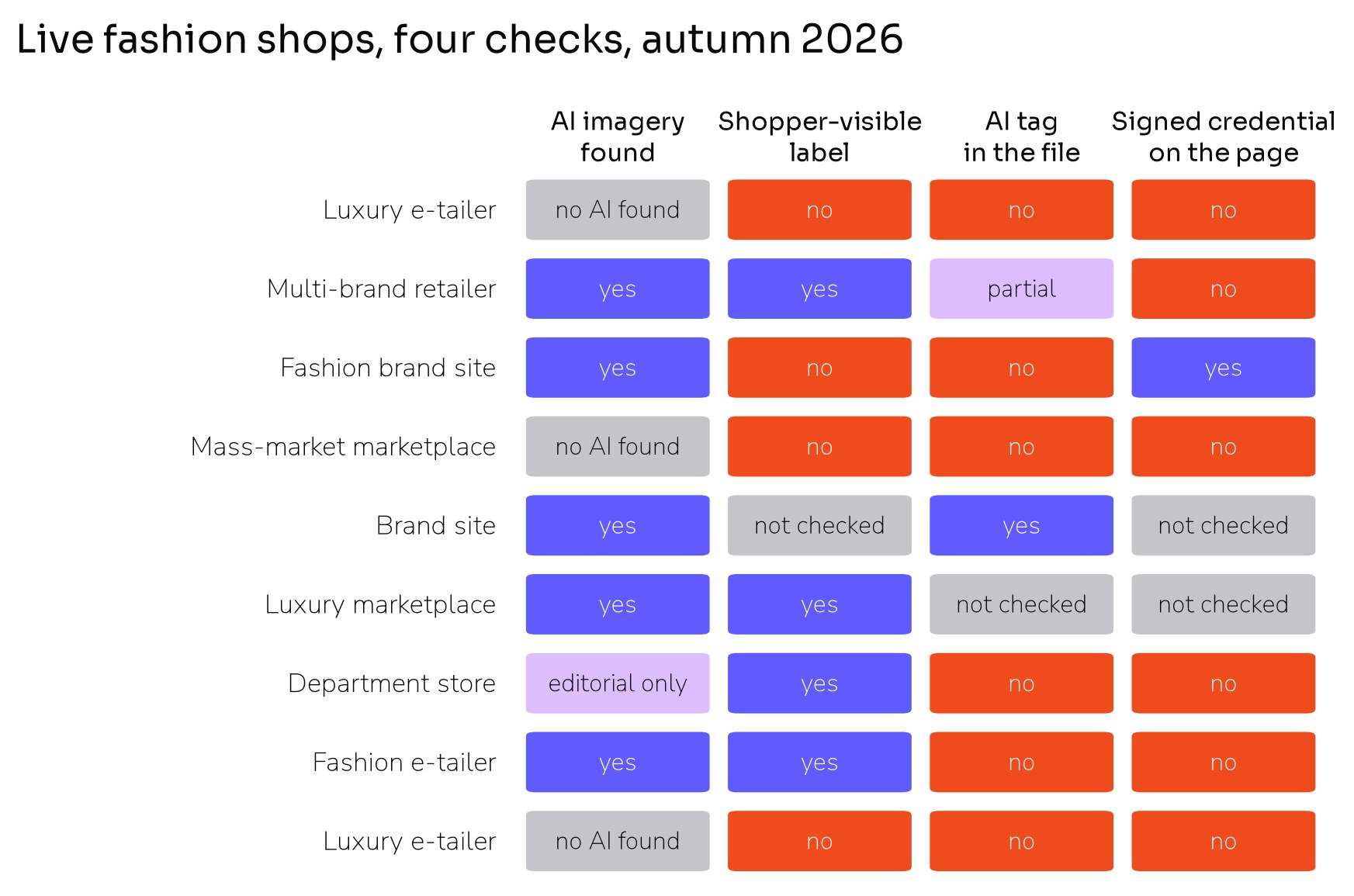
Adoption is uneven but real. On the multi-brand retailer with the widest adoption, a large share of the products in the sampled categories showed a synthetic model wearing the real garment, with the flat packshot left as shot. A luxury marketplace used AI for product video only, on a small fraction of its catalogue. A brand's own site carried AI-edited pictures across much of its range, tagged as such in their metadata. A fashion brand's own site used AI for its hero banners, not its product pictures. The luxury e-tailers and a mass-market marketplace gave us nothing: no flag, no mark, and every lead we checked by eye was a real studio shoot with a detachable sleeve or a folded hem.
Labelling is a per-shop decision, applied inconsistently. Some shops render a badge on each flagged picture. Some print a line of text on the page. Some burn a visible AI watermark into the picture itself, or print an AI label on their editorial banners. Some shops with AI imagery show the shopper nothing.
The file rarely still says what the page says. A single shop had a signed credential on a live image, on hero banners carrying the image generator's own certificate. One retailer keeps its AI tags in a single image size; the sizes the browser loads are stripped. On the shops with no AI evidence, the files carried no metadata at all, which is why "no evidence either way" is the honest verdict.
Finding 2: the mark dies in predictable places
We then pushed our own marked files through several delivery platforms, a hosted storefront, an enterprise commerce platform and a video upload, and compared the live file with the delivered one. Together with the shop audit, the same hops kept removing the mark.
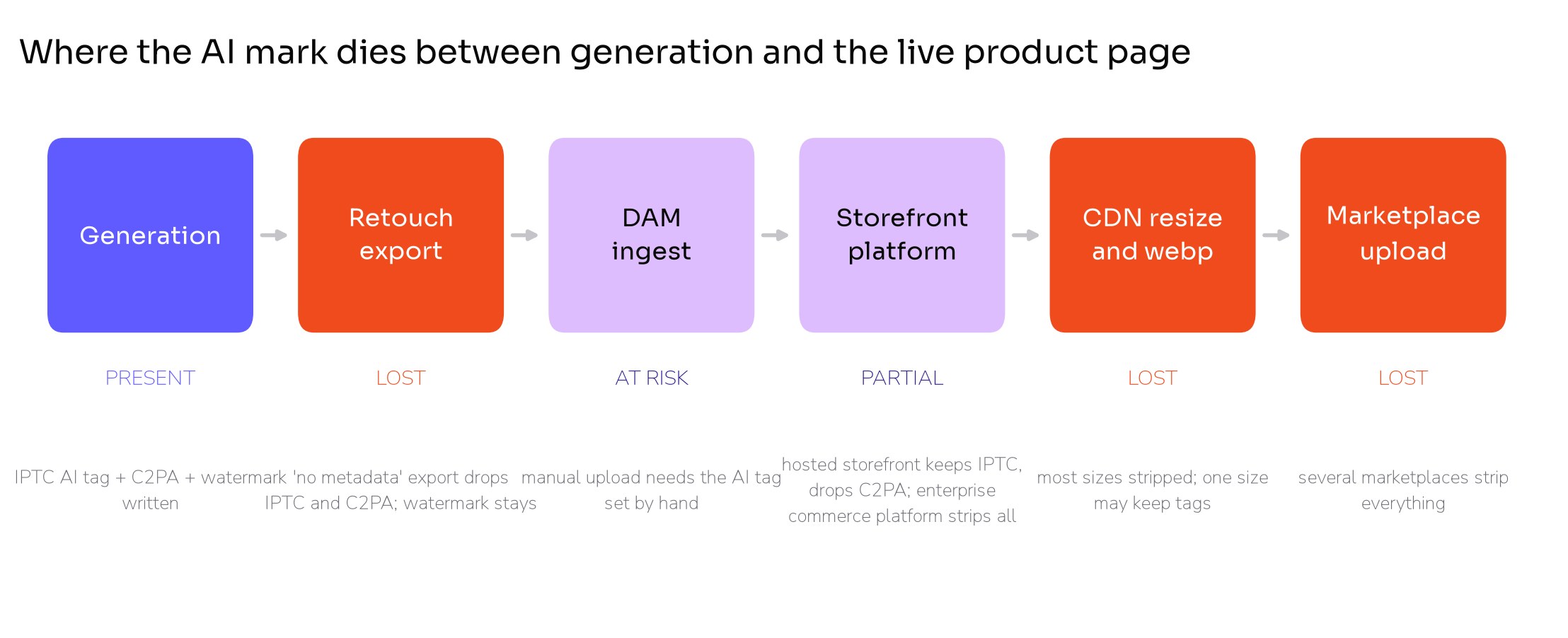
- Retouching export. An export set to "no metadata" removes the IPTC tag and the signed manifest together. The retoucher sees a normal file. The invisible watermark, which lives in the pixels, is the only layer that survives this step.
- DAM ingest. An asset manager can apply the "AI generated" tag on its API path and not on a manual upload, where someone has to set it by hand. Check both routes.
- Storefront platform. The hosted storefront kept the IPTC field and dropped the C2PA manifest. The enterprise commerce platform stripped everything.
- CDN resize and format conversion. One retailer's CDN keeps the tags on a single PNG size and strips the webp and JPEG sizes that pages load.
- Marketplace upload. In the metadata scan, several marketplaces returned files with no EXIF, XMP, IPTC or C2PA at all.
The reason is simple. A C2PA manifest signs the pixels, so any resize or re-encode breaks the signature unless the tool re-signs the result. IPTC fields are not signed and can survive a transformation, but most tools drop them by default. The watermark survives most hops, which is why the EU Code of Practice on transparency, as the IPTC summary explains, expects providers to combine more than one marking technique. In our own deliveries the fix was to apply the marks at the last step before the file leaves, after every conversion, and to verify one delivered file per batch.
Finding 3: where AI on-model pictures go wrong on the product
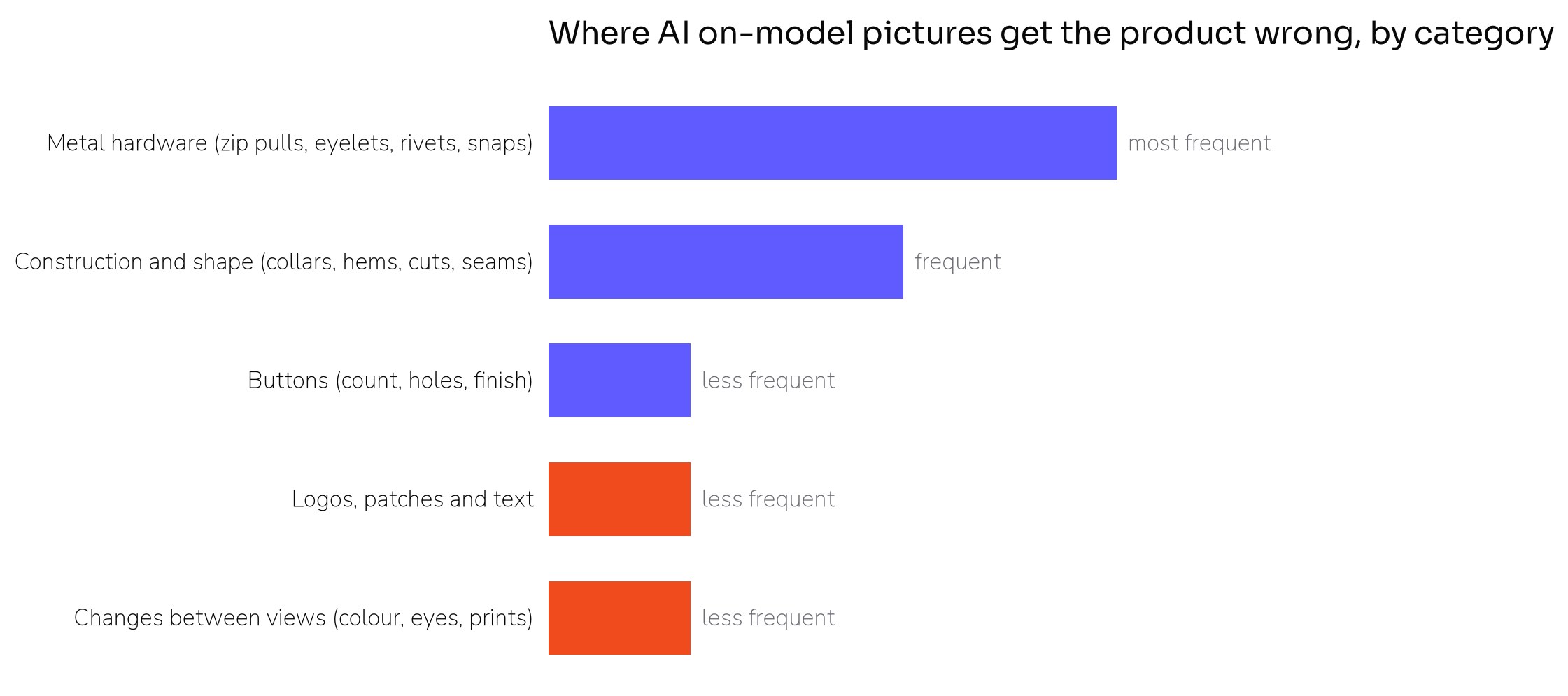
On the retailer with the widest adoption we went one step further: every AI on-model picture a human flagged was compared with the real packshot at full size. That gave a set of confirmed product errors, each on a different product. These are the error classes we see on AI on-model pictures, our own included, by category, from the most frequent down.
| Category | Frequency | Typical case |
|---|---|---|
| Metal hardware | Most frequent | A ring zip pull became a flat tab; a gold zip turned silver; eyelets on a waist cord vanished; a metal label melted into the knit |
| Construction and shape | Frequent | A polo collar became a funnel neck; an arched hem was cut straight; a keyhole became an open back; a fly sewn on the wrong side |
| Buttons | Less frequent | Plain buttons instead of gold ones, and fewer of them; buttons with the wrong number of holes; horn buttons turned plain black |
| Logos, patches and text | Less frequent | A brand name rewritten as a different word; a sleeve logo turned into a smudge; a patch becoming gibberish from behind |
| Changes between views | Less frequent | A skirt or belt changing colour from one picture to the next; the model's eyes brown in one view and green in the next |
Two patterns stand out. The errors cluster on small, high-contrast details, hardware, buttons and text, which are what a shopper zooms in on and what a returns department hears about. And the "changes between views" category is invisible on any single picture; it shows only when the gallery is laid side by side, which is how a shopper browses. A vision model alone would not have found these: its screening over-flagged hands and feet, and almost every such lead was false at full size. The confirmed cases came from a person comparing packshot and picture, zone by zone.
What this means for a brand
- Decide the label per channel, then test it on the live page. Your own shop can show a badge or a caption; some marketplaces' partner guidelines forbid on-image overlays and want the mark in the file instead. Look at the live product page as a shopper, not at the delivered file.
- Treat the file mark as something to verify, not something you were given. Push one delivered picture through your real pipeline, from retouching to CDN, and read it at each hop with a metadata tool and a C2PA verifier. Write down where each layer disappears.
- Ask for every layer. Signed metadata, the IPTC field and an invisible watermark. Whatever the vendor's setup, ask what happens after the first resize.
- Audit your own AI pictures the way we audited these. Packshot against picture, at full size, zone by zone: hardware, buttons, logos, construction, then the same product across its views. The categories above are the checklist.
How Sartiq handles it
Sartiq produces the pictures, so it sits on the provider side of Article 50. Every output carries several marking layers applied automatically: C2PA Content Credentials, XMP metadata including the IPTC Digital Source Type field, and an imperceptible watermark, applied at the last step before the file leaves so that they survive export processing. A visible "AI Generated" label can be rendered onto delivered files before they reach a brand's pipeline, switched on or off per channel, because the visible disclosure on the published page is the publisher's duty. Each download comes with a per-file disclosure receipt, and every output keeps an exportable provenance trail: prompt, parameters, model version, signing chain and revision ID, with an approval registry of who approved which image and when. Before approval, every picture is checked against the product stills the way described above. This supports a brand's Article 50 transparency obligations; it does not replace legal advice.
Key points to remember
- AI product imagery is live on most of the shops we looked at, from a small fraction of a luxury catalogue to a large share of one retailer's sampled products.
- Where AI imagery is present, most shops show some label, but the form varies from a page flag to a burned-in watermark, and one shows nothing.
- The machine-readable mark rarely reaches the live page. Retouch exports, storefront platforms, CDNs and marketplaces each remove a layer.
- A clean visual check proves nothing. Read the page flag, then the file, then look.
- AI on-model pictures fail on hardware, construction, buttons, logos and consistency between views, whoever made the picture. Those are the zones to check before publishing.
FAQ
How did you decide a picture was AI? From the shop's own flag or badge first, then from the file's IPTC Digital Source Type field or C2PA manifest. Where neither existed, we recorded "no evidence either way". We never called a picture AI, or real, from the pixels alone.
Why not name the shops? Because the point is the pattern, not the shop. Most of what we found comes from pipelines that were never designed to carry provenance, and naming a shop would turn a systems problem into a blame story.
Our vendor says the files are marked. Is that enough? It is where the work starts. Download one delivered file and verify it, then find the same picture on your live page and verify that. In our checks the two rarely matched.
Is an invisible watermark enough on its own? It is the layer most likely to survive, but it needs the provider's detector to read, and shopping platforms such as Google Merchant Center read the IPTC field. The EU Code of Practice expects more than one machine-readable layer.
Do these errors mean AI on-model pictures are not ready? They mean a picture needs the same check a studio shot gets: against the real product, at full size, zone by zone, before it goes live.